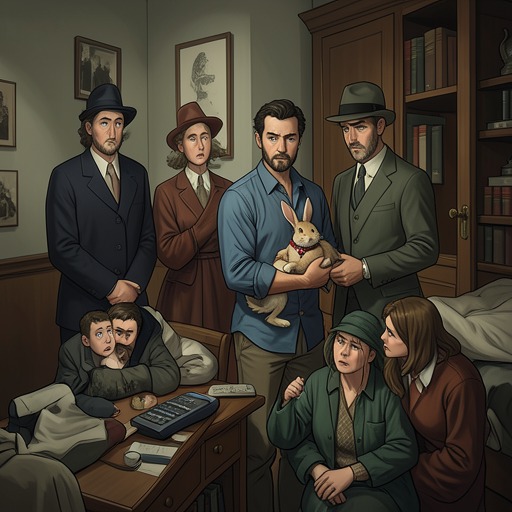
Hazel, Jasper, and Liver Flee with Hazel’s Father’s Body
Made for LoveHazel, Jasper, and Liver Flee with Hazel’s Father’s Body is the improvised escape that follows Jasper’s attempt to disable Hazel’s brain chip. Its defining choice is that Hazel will not treat flight and care for the dead as competing obligations: she insists on taking her father’s body with them, even as the group tries to disappear before her next download. The result is a tense departure shaped by surveillance, practical constraints, and the fear that Byron could turn a corpse into leverage.
The Urgent Departure
Jasper says the rabbit woman sent him to stop Hazel’s downloads and urges the group to leave before the next one. Hazel has just received an injection that Jasper says should disable the chip in her brain. The possibility that the downloads might be over brings her excitement, but it does not settle what they must do now. She warns that Byron will kill Jasper, registering the danger of his intervention even as the group prepares to move.
Hazel’s attention turns immediately to the blanketed body of Hazel’s Father (Herbert). She puts a hand on his chest and objects to leaving him behind: she fears Byron will find the corpse and use it for cryogenic blackmail. The danger is therefore not simply that the group might be caught during their escape. Leaving the body would expose it to the same man they are fleeing, who could make its preservation another instrument of control. Hazel repeats that they must take him, then asks how to keep him cold; Jasper had worried that she might be concussed or in shock, but her practical question shows her thinking through the problem.
Turning the Body into a Logistical Problem
Jasper offers the cooler in his car, which is large enough to hold an adult human. Its unusual size—he describes it as dolphin-sized—makes it possible to transport the body without abandoning it. Hazel and Liver both turn to look at him, and Liver accepts the plan. Hazel then grabs Jasper’s arm to ask how many people the car can seat, making the vehicle’s capacity the next immediate condition of escape. The scene’s darkly practical tone emerges from this sequence: an emergency injection, a corpse that cannot be left behind, and a cooler large enough to contain it all lead directly to the question of passenger space.
The body’s destination remains unresolved. Hazel considers what her father would have wanted: a conventional burial, a wake with visiting hours, and a notice in the paper. She concludes that those arrangements would not be safe, since Byron might locate the funeral and have the body dug up. She thinks the body may have to be destroyed, though she has not decided how. As a consolation, she imagines letting her father leave with the dolls, like a pharaoh furnished for the afterlife. The possibility makes the escape more than an effort to get Hazel away from Byron: it also becomes a search for some way to honor her father under circumstances that deny him an ordinary funeral.
The Improvised Funeral Procession
In Jasper’s station wagon, the group first tries arranging Diane and Roxy around the cooler. The realistic body parts make the arrangement look like a suspicious tangle, so they instead dress the dolls in aviator sunglasses and baseball caps and strap them into the back seat. Liver sits between them, an arm around each, grinning. His pleasure at the journey is undercut by his acknowledgment of the morning’s circumstances: Hazel’s near-suicide and her father’s death. The dolls, intended as a consolation for the dead man, become conspicuous companions in a scene that is at once an escape and a makeshift procession.
Jasper keeps his attention on the road and follows a clockwise checking routine: rearview mirror, right-side mirror, left-side mirror, then the road ahead. He is especially concerned about the police. About forty minutes into the drive, he raises the question of sending the body to rest soon in case they are pulled over. His worry is practical rather than ceremonial: the body is in the car, and he wants to avoid police intervention. The exchange keeps the escape’s immediate risk in view without supplying a safe destination or a settled plan for the burial.
Competing Plans and Unfinished Flight
Before leaving Hazel’s father’s home, Liver suggests making the task simpler by setting fire to the house and body with kerosene. Hazel vetoes the plan because the flames might spread to neighboring trailers, whose residents mostly have mobility issues. Jasper also rejects it, out of a desire to avoid police attention. Their reasons differ, but both refusals narrow the group’s choices: Hazel will not endanger the neighbors, and Jasper will not invite law enforcement into an already precarious flight.
The group also disagrees over how quickly the body should be dealt with. Jasper tries to persuade Liver to wear one of Hazel’s father’s button-up polos and khaki shorts embroidered with tiny lobsters; Liver refuses to put on a shirt. Jasper’s irritation surfaces during the drive as he watches Liver in the rearview mirror and urges Hazel to consider the risk of being stopped. Hazel agrees that the body must be laid to rest but is not sure how. The departure thus remains unresolved on several fronts: the chip’s disabling has only just been attempted, the body cannot safely be left behind, and neither its final disposition nor the group’s destination is established in this passage.